
Next.js App Router defaults all components to Server Components.
The "use client" directive marks a file as a Client Component.
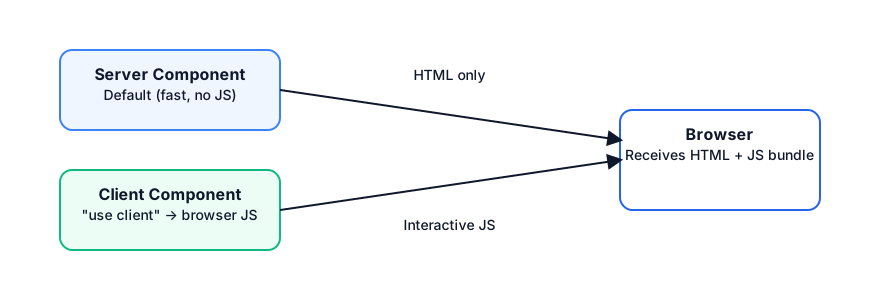 use client
1) What does it do?#
- Placed at the top of a file:
"use client"; - Tells Next.js: render this component on the client (browser).
- Without it → the file stays a Server Component.
tsx
// Button.tsx
"use client";

export default function Button() {
  return <button onClick={() => alert("Clicked!")}>Click me</button>
}
Without "use client", this would break: event handlers & useState only work in the browser.
2) Why is it needed?#
- Next.js defaults to Server Components for speed & smaller bundles.
"use client"is an escape hatch when you need client-only features.
3) When to use it?#
You need "use client" if you use:
- React hooks:
useState,useEffect,useRef - Event handlers:
onClick,onChange, … - Browser APIs:
localStorage,window,document - Client-only libraries: Chart.js, React-Quill, etc.
4) How does it work internally?#
- Next.js scans for
"use client"at build time. - That file + its imports → shipped as JS bundle to the browser.
- Server Components are stripped to HTML + serialized props.
5) Mixing Server & Client Components#
- Server Components can import Client Components.
- Client Components cannot import Server Components.
tsx
// page.tsx (Server Component)
import Button from "./Button";

export default function Page() {
  return (
    <div>
      <h1>Hello</h1>
      <Button />  // Client-side, interactive
    </div>
  );
}
6) Mental Model 🧠#
- Default = Server Component (fast, no client JS).
- Add
"use client"only where you need state, events, or browser APIs. - Sprinkle sparingly → keep most of your tree on the server.
⚡ "use client" is the switch that brings React interactivity into your Next.js App Router components.

Start the discussion
Questions, corrections, a better approach? I read and reply to every comment.